
Enormous expansion of your target audience
If you’ve been in business for a while, there’s probably no faster way to expand your target audience than with digital accessibility. Around 20% of people live with a disability that prevents them from properly using inaccessible websites. This means you could be losing 20% of potential customers who leave your website immediately because of its lack of accessibility.
To better illustrate this connection, a Microsoft study on accessibility calculated how a non-accessible website can affect annual revenue:
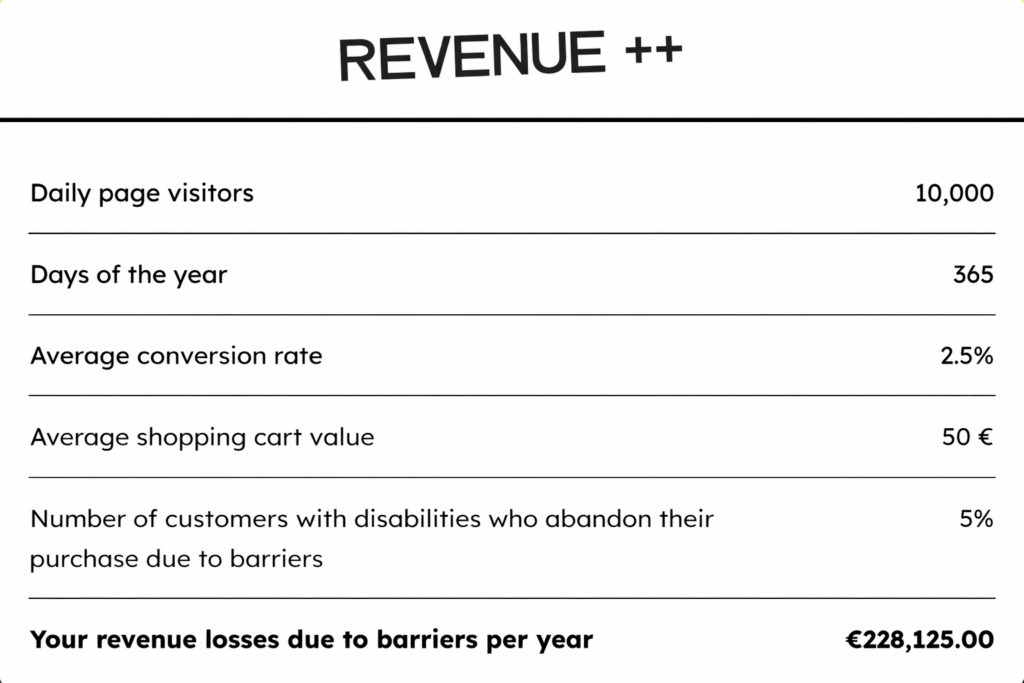
By making your website accessible, you can expand your target audience by at least 5% (conservative estimate). The costs of these adjustments are generally significantly lower than those of traditional conversion rate optimization measures.
Furthermore, there are already studies showing that relatives of people with disabilities also avoid companies that exclude their loved ones due to a lack of accessibility.
And finally, we mustn’t forget that we are all getting older. Only 3% of all people are born with a disability, while 97% of disabilities develop over the course of a lifetime due to accidents, illnesses, or aging.
This means that by lacking accessibility, you not only exclude potential customers but could also lose long-standing customers.
Brand building for more customers and employees
The accessibility switch not only directly expands your target audience but also significantly influences your brand’s image.
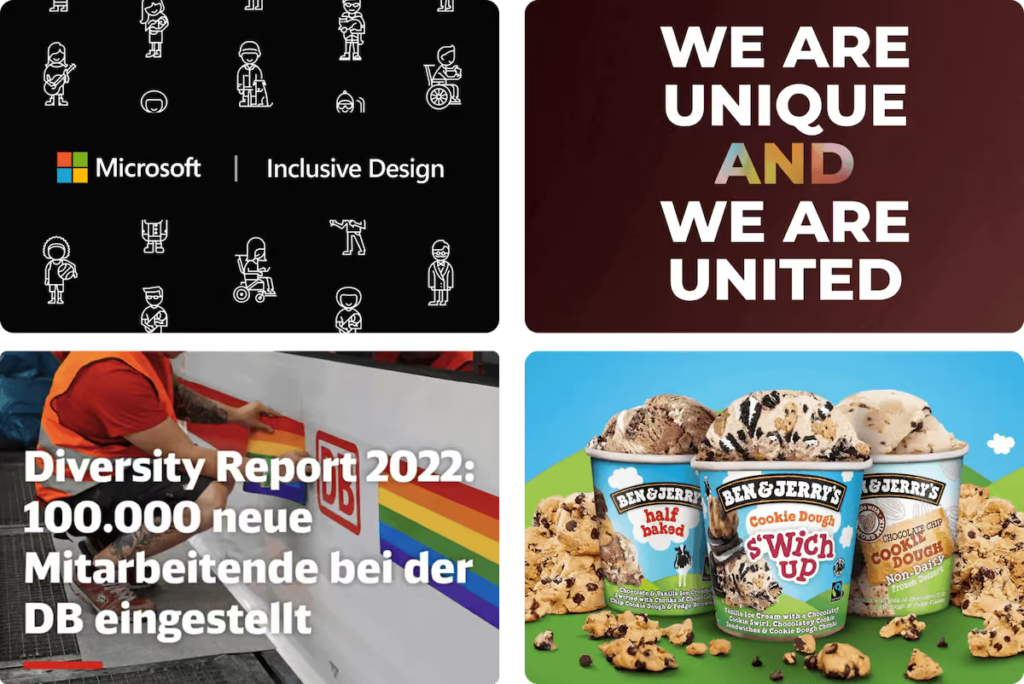
These days, we no longer simply choose companies but responsible actors. We look for brands that stand by their values and are committed to the environment and society. This applies to both consumers and potential employees.
Here are some hard figures:
- 77 percent of consumers worldwide pay attention to the social commitment of the companies they shop at.
- 63 percent of German consumers are willing to pay more for products if the company demonstrates social commitment.
- 62 percent of German consumers prefer brands that are committed to a good cause.
- 77 percent of millennials value the social or environmental responsibility of companies when looking for a job.
- 48 percent of employees would even accept a lower salary for companies that are committed to a good cause.
- 38 percent of employees in socially responsible companies are more committed to the company’s progress.
Now is the perfect time to position yourself as an inclusive and responsible company and demonstrate this by switching to digital accessibility.
If the law takes effect and becomes mandatory for everyone, the transition will be perceived not as a good deed but as coercion. By taking action now and advancing your digital accessibility, you voluntarily signal your intention and commitment.
By making your digital presence accessible, you not only demonstrate your openness to all users but also position yourself as a responsible company that cares about the needs of all people.
This will help you gain your customers’ trust and attract talented, dedicated employees who identify with your values.
Switching to accessibility can greatly help your brand be perceived positively.
Avoid lawsuits
Another important aspect that will become relevant from 2025 onwards: legal consequences and possible lawsuits.
The Accessibility Strengthening Act requires companies to ensure the accessibility of their products and digital presence.
In the future, companies must ensure that people with disabilities, older adults, and people with limited mobility can use their products and digital services without encountering barriers.
The law stipulates that companies that fail to meet these requirements can be fined. This ensures that accessibility is no longer ignored and that everyone has an equal opportunity to use products and digital services.
If you would like to learn more about the legal obligations and deadlines, we recommend reading the following link: [Link to legal information]. There you will find detailed information, based on our conversation with a lawyer, about what needs to be done now.
By making your digital content accessible early on, you can not only avoid lawsuits but also strengthen your customers’ trust.
Show your willingness to respect and meet the needs of all users to create an inclusive and accessible online environment.
Improve your SEO through digital accessibility
A comprehensive study by SemRush and Accessibility Checker has shown that accessibility is of great importance for search engine optimization (SEO) of websites. (Study on the impact of accessibility and SEO)
The study examined 847 websites, which were subsequently made accessible. The result was an average increase in organic traffic of 12 percent.
Of all participants, 73.4 percent recorded an increase in their visitor traffic, while 26.6 percent had fewer visitors. For 66.1 percent of all websites, the number of monthly visitors increased by up to 50 percent.
The close link between SEO and digital accessibility stems from the fact that both focus on making websites easier for machines to read. A machine-readable structure is crucial for both SEO crawlers and screen readers, which blind people, for example, use to access websites.
Therefore, for example, it is advantageous to improve the HTML and link structure and to add appropriate alt texts to promote both search engine optimization and digital accessibility.
By making your website accessible while also considering SEO, you achieve a win-win. You increase your website’s visibility in search results while improving accessibility for all users, which reduces your bounce rate.
Less support effort
Switching to accessibility can help reduce support efforts. This could be because accessible websites are more accessible to all users and have fewer barriers.
This allows people with disabilities or older people to use the websites more easily and potentially requires less support. This can positively impact the efficiency and cost of customer support for companies.
The following calculation example also comes from the aforementioned Microsoft study.
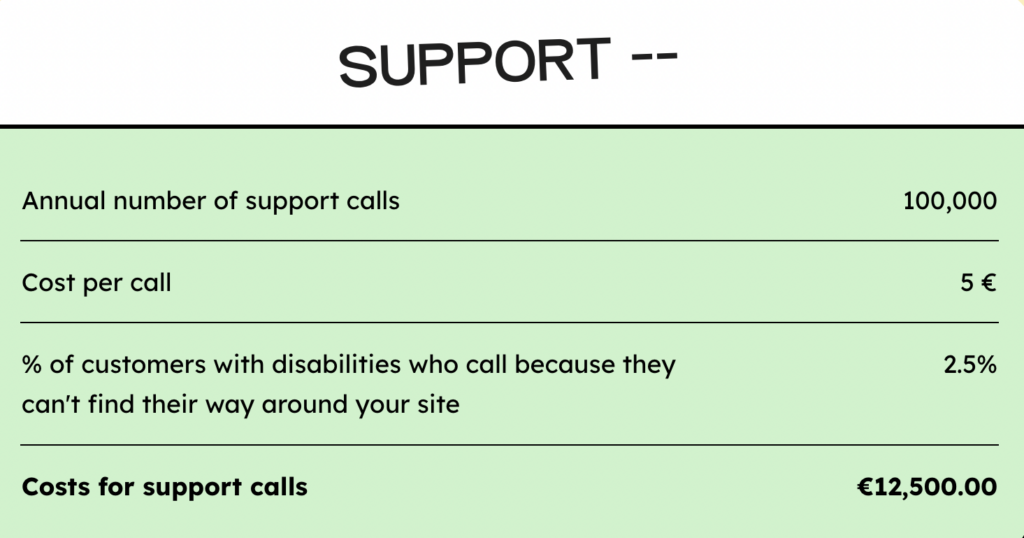
By switching to an accessible website, companies can reduce the number of support requests and save time and resources.
This allows the support team to focus on other important tasks and improve customer service efficiency.
The target audience is looking for favorite brands.
As already mentioned, now is a good time to become popular in the field of accessibility.
In Germany, this target group is still largely excluded. A few brands cater to this group’s needs. At the same time, this target group also lacks a connection to brands that inspire them, win their hearts, and that they are happy to recommend.
By addressing accessibility now, you have the opportunity to tap into a target group you won’t lose easily!
Making your website accessible and offering your products or services accordingly can win the trust and loyalty of this target group. You and your brand will be perceived as pioneers in accessibility.
By committing to accessibility, you can not only reach a new target group but also build new, strong relationships with your customers.
Conclusion: Why you should become digitally accessible
The importance of digital accessibility for companies and their online presence should not be underestimated.
The upcoming EU directive and the associated legal obligation are just one aspect urging companies to make their websites accessible. But even apart from legal requirements, there are many good reasons to advocate for accessibility.
The most important advantages are expanding the target audience and influencing impact and brand image.
Especially at a time when brand understanding is highly value-oriented and finding both customers and employees is difficult, it is important to stand out in the market and demonstrate one’s social commitment.
Finally, it’s important to remember that transitioning to accessibility is not just an obligation, but also an ethical issue. By making their websites and products accessible to everyone, companies contribute to inclusion and equality.
Accessibility is therefore not only a legal requirement, but also a way to unlock the full potential of your brand and create an inclusive, accessible online presence that reflects the values of today’s society.