
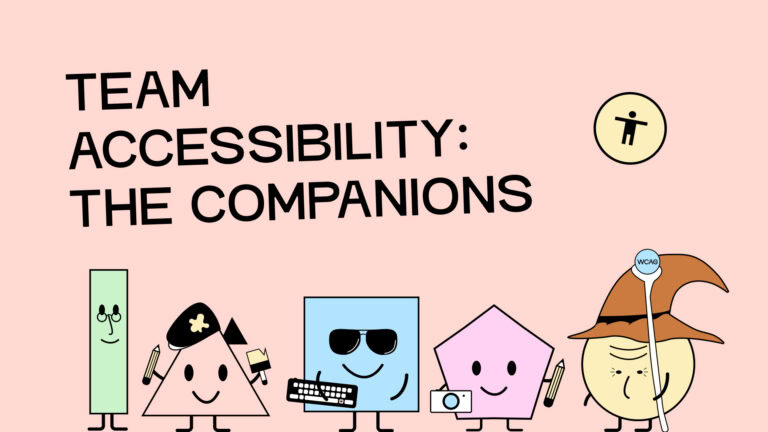
This article provides a brief overview of the roles typically found in a website project team and the responsibilities of each individual regarding digital accessibility.
We assume here that a whole team is available, which, of course, isn’t always the case. Often, one person has to wear several hats, which, however, doesn’t change the responsibility of each role in theory.
There are certainly other relevant voices in the digital accessibility ecosystem, such as legal or sales perspectives. However, these are not directly related to the website or app creation process and are therefore not considered here.
Product Owner
The project manager is responsible for leading the entire project and overseeing everything. But is it also their job to be an expert in digital accessibility? Probably not.
However, the Po should sit down with the tester and define the Definition of Done in terms of accessibility for the project and each task.
UI / UX Designer
For me personally, this is one of the key roles when it comes to accessibility. Firstly, it is their job to ensure the user-friendliness of the final product and to consider the needs of its users; secondly, UX designers have a very big responsibility when it comes to accessibility.
The designer makes fundamental decisions that greatly influence the developer and can therefore either save a lot of money or incur high costs in the future.
Designers decide on:
- The arrangement of elements (general usability)
- The colors
- Typography
- The use of animations
- The use of components (such as sliders or modals)
Last but not least, in my opinion, the designer is also responsible for communicating the accessibility of their design to the developer.
Developer:

Developers also make crucial decisions regarding accessibility. This includes the choice of frameworks (e.g., Kolibri), code, and architecture, all of which strongly influence how accessible an application is or can be made.
However, they are heavily dependent on the designers’ whims. (Unless, of course, the developers choose the framework and the designer has to stick to it!)
Content creators are also dependent on them, depending on which CMS was chosen and how easy or difficult it is to integrate accessible content.
Content Creator:

Content creators must write understandable texts, add alt text to images, add subtitles to videos, etc.
They are responsible for ensuring that not only the website’s structure but also its content is accessible. However, no one else on the team depends on their work.
Tester:
If you can afford to have a tester on your team, you’ve found your accessibility superstar. Testers have the most knowledge and the most comprehensive overview of accessibility. They are the wise advisors who are always ready to help and support everyone on the team!
They use their knowledge to help:
- Define the Definition of Done with the Product Owners
- Slap designers on the wrist when they get too creative again
- Advising developers on structure & architecture
- Raising awareness of problems among content creators
Conclusion
Everything said here about who is responsible for what on an accessible website can, of course, vary considerably depending on the context and team size. In my experience, there’s often no dedicated tester, the product owner is too busy with other tasks, and the real responsibility for advancing accessibility falls to the designer. That’s why the designer is my secret favorite on this list.
