
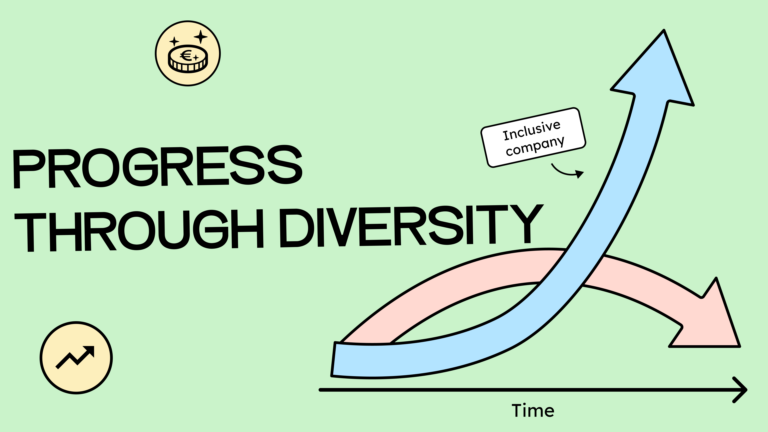
I will not delve into the moral or ethical reasons for creating a more inclusive society. As a team, we clearly believe that it is right and important not to exclude anyone and to see everyone as an important part of society. However, what is right and important is, as we know, highly subjective. Therefore, I want to focus on a more objective reason to argue the relevance of inclusion and diversity. I want to illustrate, from a rational rather than an emotional perspective, why greater inclusion is essential for our future.
There was a time…
In the last century, to put it simply, one thing was paramount for companies: efficiency. They wanted to produce as much as possible, as quickly as possible. To achieve this, they needed pretty much a stereotypical worker: strong, fast, fit, and obedient! The more efficient the employee, the more was produced, and the more money was raked in.

From an economic perspective, it was simply a losing proposition to hire someone physically weaker (women), who had other limitations (people with disabilities), or who spoke a different language (people of different origins). Hiring someone who didn’t have the prerequisites to be maximally efficient was therefore always a losing proposition.
While the Industrial Revolution brought us factories and machines, it also brought us piecework. Humans became mere extensions of the machine. And this is still the case today in many efficiency-driven workplaces.
Anyone who’s ever worked in an Amazon warehouse probably knows what I’m talking about. Any human emotion is a hindrance in such environments. Your sole purpose is to do your job, and preferably as quickly and precisely as possible. Even going to the bathroom was (or is) punished in Amazon warehouses in England. (Anyone who went to the toilet three times lost their job. Source: Article about miserable working conditions at Amazon)
And let’s not kid ourselves: if they could, all companies would immediately replace people with machines for such tasks, which brings us to the good stuff: robots! Or rather: the internet, digitalization, progress, and technology.
We’re gradually working our way out of the age where humans are mere substitutes for machines. And that’s only because we’re creating one thing: machines that can replace humans (Yeah!) – at least when it comes to repetitive tasks.
That’s a good thing! The more efficient robots there are, the less a person has to torture themselves by pretending to be a robot for 8 to 10 hours a day! The more machines take over the boring, repetitive tasks, the more time humans have to do human things. I know this might come as a surprise, but one thing humans are relatively good at is thinking and being creative!
It turns out that when a machine takes over your boring job, you have more time to think. And the more time you have to think, the more likely you are to come up with new ideas!
The new way of working.
I maintain that you and 95% of the people who ever read this blog post are “knowledge workers .” This means you’re primarily paid to think. You earn your money by designing, coding, leading a team, running a business, or something similar. Yes, there’s a bit of “craft” involved in all of these, but you spend most of your day “thinking.”
And that’s the case for quite a lot of people in quite a lot of companies these days. Companies have discovered that thinking can be very lucrative. For example, those who manage to make work processes more efficient save money, and those who then sell this knowledge make even more money.
And to make work processes more efficient, we need new ideas. It’s no longer just about being able to produce something to survive in the market. Anyone can produce whatever they want these days. You can open a Shopify store right now and start selling. It doesn’t matter what you want to sell; China has it or is producing it for you – guaranteed!
The question is no longer “Can I sell this? “, but: “How can I market it better than my neighbor?”
And for that, you don’t need efficient employees, but good ideas! Of course, this isn’t a new insight. We’ve known for quite some time that thinking helps and that innovation gives you a competitive edge.
The question many companies are currently facing is: “Where do the innovative ideas come from that promote growth and make my company future-proof?”
And the problem that many people have and don’t realize is: Shit in → Shit out.
Why inclusion is the only way forward.
Imagine innovation is a magic box. You feed this box with information, and based on what you feed it, it spits out ideas.

Cool! So you start feeding the box with your knowledge. That means you feed it Western, European ideas. With your culture, your values, your way of speaking, your opinions, and so on, this box delivers brilliant innovations in return. At least, that’s how it was… in past decades.
By now, at least the large companies have recognized the problem. If you constantly feed your magic box the same information, you’ll always get the same result. This doesn’t lead to any innovations, and it doesn’t get us anywhere, especially if we want to maintain a competitive edge.
That’s why someone came up with a clever idea: We change the information we feed into the box. This new information includes different perspectives, different values, different cultural concepts, and so on. It turns out that the more diverse the variables you feed into the magic box, the more creative, new, and unique the results.
There you go: Variety and diversity!
Study after study shows that a diverse group (in terms of origin, gender, and age) generates more creative ideas than a relatively homogeneous one. Different people have had different experiences, seen different things, formed different neural connections, and so on. When you combine all of that and stir it up, something new can only emerge.
Greater inclusion makes us more creative. Why? Because it allows us to look at a problem from different perspectives. Different people examine a problem from different angles, leading to new solutions.

The experiences and events that a deaf person has every day allow them to perceive the world in a completely different way than you ever could. No matter how empathetic, creative, or intelligent you are, you will never be able to adopt the perspective that another person has developed over a lifetime.
That’s why we need diverse people and perspectives to remain innovative as a company. We can’t do it alone, and a homogenous group of people can’t either. It’s time to understand that diversity means creativity. Creativity leads to innovation, and innovation is the only path to future growth.
Those who refuse to embrace diversity and inclusion will not face a very bright future, either as a company or as a country. We should begin to leave behind the age of efficient work and focus on effective work.
Yes, it takes more time to restructure your internal systems so that people from other cultures and people with disabilities can work in your company. And yes, it makes certain communication and processes more difficult and slower. But these are only problems if we measure our work by efficiency. As soon as we start evaluating the effectiveness of our work, these arguments from above no longer matter.
Or, to put it in more clever terms, from an author I unfortunately don’t know:
“Stop trading time for money, start trading value for money.”
Finally, here’s a McKinsey study showing that companies with greater gender and ethnic diversity have a competitive edge. The likelihood of delivering better financial results increases by 25% with greater gender diversity and by as much as 36% with greater ethnic diversity. You can find the full McKinsey article on the added value of inclusion and diversity here.