
Plain language is designed to convey information as clearly as possible. We’ve all heard the approach: “Explain it to me like you would to a child!” This works so well because it helps us focus on the essentials when explaining.
We accumulate more and more knowledge throughout our lives – and that’s both a blessing and a curse. The more we know about a subject, the more we want to talk about it. And we prefer to do so using technical jargon or a large vocabulary. After all, we want to show what we’ve learned. However, this often makes our communication complex and stilted. And that doesn’t reflect well on us at all! Texts become incomprehensible and presentations tedious. Above all, meeting people with diverse backgrounds and educational levels can be confusing.
What constitutes plain language
Plain language can be a good common denominator for successful communication. The goal of plain language is to reduce the content to its core and simplify the vocabulary. Easy-to-read languages are similar. However, there are differences between the two. Plain language is still more complex, essentially a middle ground between easy-to-read language and standard language. You can find more information about the difference between easy-to-read and plain language here.
It’s not yet clear whether plain language, such as easy-to-read language, will be entirely based on a set of rules. (However, a DIN standard is currently being developed.) Therefore, different criteria for plain language can apply in different contexts. What is perceived as simpler can be adapted depending on the target group.
But don’t worry: Although there isn’t (yet) a fixed set of rules, some basic principles can still be established as a guide.
Who benefits from plain language?
Plain language is a true all-rounder. Everyone is invariably happy when information is conveyed directly and simply – that’s a promise! A fun example is the website Lol-My-Thesis.
On this site, complex theses with even more complex titles are broken down into a single, simple sentence. Eureka!
An example:
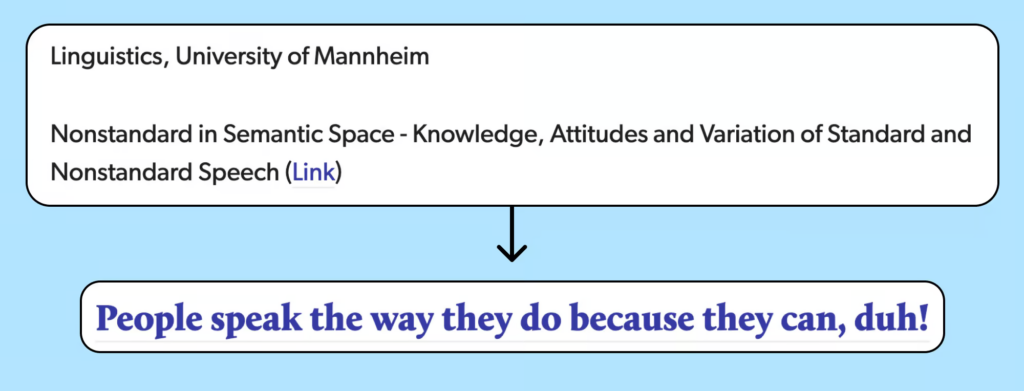
In this example, the linguistics thesis from the University of Mannheim is summarized as follows:
“Nonstandard
in Semantic Space – Knowledge, Attitudes and Variation of Standard and Nonstandard Speech.”
becomes
“People speak the way they do because they can, duh!”
This is certainly a very humorous way to simplify language. But it vividly illustrates the contrast between convoluted technical jargon and a simple core message.
Plain language, therefore, benefits not only people with low-literacy or people with limited language skills, but also anyone unfamiliar with a particular subject area. Or even anyone who simply doesn’t feel like thinking (that’s practically everyone online!).
For information on illiteracy, see the National Literacy Trust website.
To understand more precisely how many people benefit from simplified language, let’s look at the language levels in English. These were defined by the Common European Framework of Reference for Languages (CEFR). They are divided into three categories:
- Basic language use (A1 Beginning, A2 Basics)
- Independent language use (B1 Intermediate, B2 Upper Intermediate)
- Competent language use (C1 Advanced, C2 Excellent)
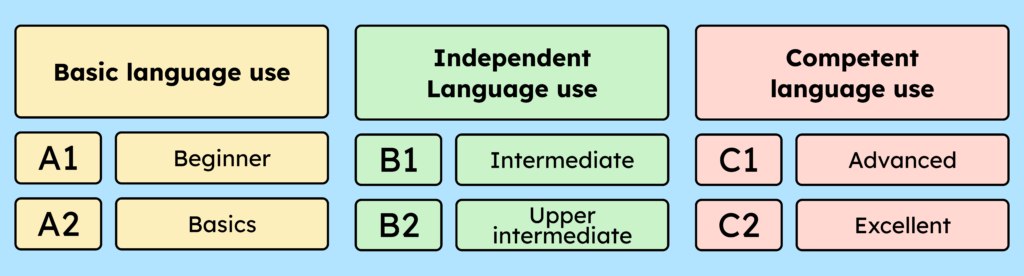
In terms of language proficiency, simple English is roughly equivalent to levels A2 to B2. This corresponds to the language comprehension of approximately 86% percent of people in the United Kingdom. Only about fourteen percent of people understand language levels C1 and C2 – that is, advanced and excellent English. A very good reason to keep things simple, right? You can find more statistics here at OECD.
What do I generally need to keep in mind when writing simple texts?
As I said, there are no hard-and-fast rules. However, there are definitely points you can follow to make your texts more understandable to everyone.
Here is a list that applies to both speaking and writing:
- Avoid foreign words, abbreviations, and technical terms – or explain them.
- Structure your texts and presentations effectively.
- Be unambiguous. (Avoid irony, metaphors, or synonyms.)
- Use active sentence structures.
(Not: “A graphic is being viewed.” but “We are viewing a graphic.” ) - Avoid negations.
(Not: “Not unimportant here…”, but “Important here…” ) - Avoid abstract words that are open to interpretation.
- Use concrete language (e.g., tangible, sensory words) so listeners can imagine what is being said.
- Make each sentence no longer than your breath allows when reading it aloud.
- Each sentence should contain only one thought.
- The words should be generally known and as unambiguous as possible: “ money ” instead of “ means of payment ” or “ church ” instead of “ house of worship ”.
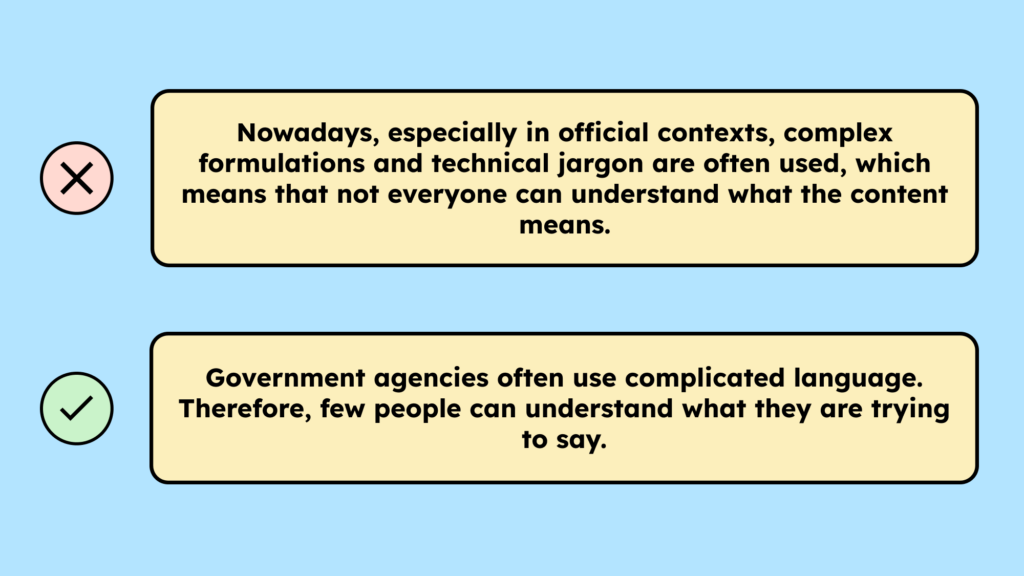
Example of a sentence with passive voice: ” Nowadays, especially in official contexts, complex formulations and technical jargon are often used, which means that not everyone can understand what the content means.”
Example of the sentence in the active voice: “Authorities often express themselves in complicated ways. That’s why few people can understand what they want to say.”
Everything you need to know about creating accessible content!
- What types of content actually need to be accessible: social media, websites, newsletters?
- What requirements apply to content, and how do you implement them—without missing anything?
- How do you integrate accessibility into your daily workflow without it becoming a major extra burden?
Through theory and practice, we’ll show you what we’ve taught participants—from Aktion Mensch to Deutsche Bahn—over the past three years!

Tips for easy writing
Short and sweet!
You can simplify written texts by using short sentences. Avoid using more than one comma. Long words should ideally be replaced, rephrased, or made more readable with hyphens. Keep paragraphs short as well. Visual breaks help the brain process information.
A good rule I learned in my advanced German class:
When your text is finished, delete words that aren’t essential for understanding. Let’s be honest: we’re all a bit like phrase-mongers. Many words are just filler. They unnecessarily lengthen sentences and waste valuable reading time.
Example sentence with many filler words: “So, I think it would actually be a good idea if we went to the cinema tomorrow, instead of today.”
The same sentence, without filler words: “Let’s go to the cinema tomorrow.”
Short doesn’t always mean simple. A short word might be a complex foreign word, or an unfamiliar abbreviation. This can render the entire text incomprehensible. A brief insertion can disrupt the flow of reading far more than enclosing the information in a second sentence. Therefore, always question your decision to shorten the text.
Specialist texts
As already mentioned, domain-specific language can make even short texts difficult to understand.
Especially in the area of so-called “officialese,” there is still much room for improvement in comprehensibility. In a study conducted by the National Library of Medicine, out of 180 public-facing documents, there was only one “easy-read” document that met accessible reading-age expectation.
You can find the source for this study on the National Library of Medicine website.
It is hardly surprising, since, according to the OECD (Organisation for Economic Co-operation and Development), 18% of working-age adults have very low literacy skills. To extract information from a text, they need short sentences with simple vocabulary.
You can find the source for this survey on the National Literacy Trust page.
Therefore, it is also important to use simple language in specialized fields. Government offices and official bodies, in particular, should express themselves in a way that is “citizen-friendly,” which, in this context, is used as a synonym for “simple.”
Appearance and Structure
Don’t worry, we won’t reduce your text to its exterior now that it’s beautiful on the inside!
However, if you pay a little attention to the format, your text will be much easier for the reader’s brain to grasp.
This includes, as with accessibility, a large font size with easily recognizable letters.
You can create a structure with the paragraphs mentioned above. This can be further supported with subheadings. The result is a visual and content-related organization. This allows readers to pause at any time without losing the thread. Each short section is a self-contained, meaningful unit.
Unlike simplified language, illustrations are not mandatory, but they can enhance comprehension. And who doesn’t love a relaxing visual break from the vast sea of text?

Tips for Simple Speaking
Now that we’re all comfortable with the text and refreshed, let’s turn our attention to the spoken word. The good news is: the same rules apply as for written texts, and we already know those!
In addition, when speaking simply, you primarily need to pay attention to the acoustics:
- Speak slowly and clearly! (Often it’s just clear enough when you start to feel a little silly.)
- Avoid dialect words, foreign words, or colloquial language.
- Avoid Anglicisms.
- Be direct, avoid innuendo or irony.
- Maintain eye contact. Looking into your face can aid understanding
- Avoid filler words (“ Um, yeah… exactly ”) and unnecessary repetitions.
- Address the other person directly.
- Take breaks (in your speech). Give the listeners time to process what they have heard and to ask questions if necessary.
It’s easy to fall back into old patterns, especially when speaking. You can’t just skim and shorten a sentence. This can put you under pressure and lead to getting even more confused. If you want to be sure you’re expressing yourself clearly, record yourself. Listen to yourself. Find out what filler words you use. Which phrases can you eliminate from your vocabulary? You can also get feedback from those around you. And once you’ve gathered your insights, remember: practice makes perfect!
Conclusion on plain language
The beauty of simple language is: you don’t have to learn anything new! Instead, you can forget something you’ve already learned and go back to basics. Get rid of the baggage. Simple language is well worth it, as we’ve known since reading this article. Because you reach more people. You improve your SEO with clear words. You increase your conversion rates with direct, simple communication. Learn more in this study about how the readability of your website influences your conversion rate.
You put more thought into the core of your message. You save time in the long run by communicating more efficiently. (And, hey, time is money, As we all know, you can always use more of that!) And to get back to our starting point: we don’t need jargon to impress with our knowledge! Because the simpler we speak, the better we are understood. The better people understand us, the more competent they perceive us to be. They gain trust because what we say makes sense. You can find more on this in this article from Science Daily. All these points make it a real advantage to express yourself simply.
So stick with it and keep it simple!
