
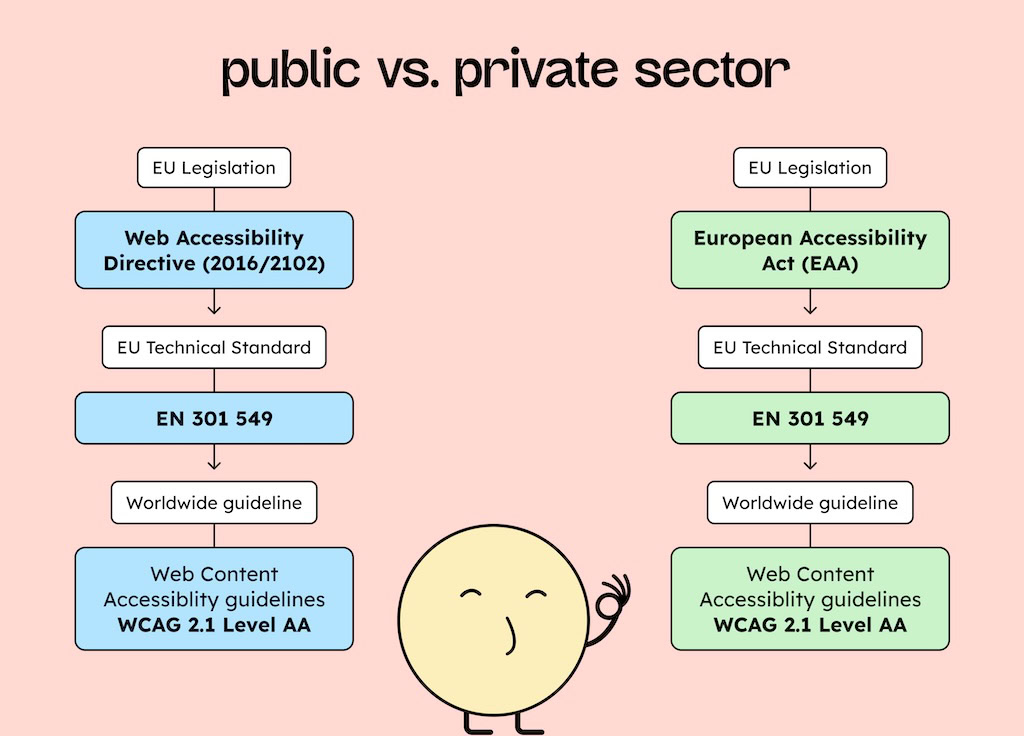
First and foremost … EN 301 549.
EN 301 549 is the main European accessibility standard. For the Public sector, the Web Accessibility Directive (2016/2102) requires government websites, apps, and digital documents to meet EN 301 549. For EAA-covered private-sector products and services, EN 301 549 is the primary technical benchmark used to demonstrate compliance for digital services. However, EN 301 549 is not a law but a technical standard. Legal obligations within the EU come from the EAA, which is transposed into national law.
What is WCAG and why does it matter?
WCAG (The Web Content Accessibility Guidelines) is an internationally recognized accessibility standard. WCAG helps define how to make web products accessible to people with disabilities. The current version, which is used in most accessibility frameworks, is based on four principles: Perceivability, Operability, Understandability, and Robustness (POUR); and three conformance levels: Level A (basic), Level AA (the level usually required by accessibility laws worldwide), and Level AAA (enhanced). As Level AA is typically the standard within most European accessibility frameworks, concepts such as sufficient color contrast, keyboard navigability, proper heading structure, and text alternatives are requirements in many compliance contexts. However, not every web product is automatically covered by law; the EAA legal obligations apply to specific product and service categories, not all websites of digital products.
By understanding WCAG and the guidelines it defines, one can better grasp the accessibility laws that must be complied with when designing a product or website.
The Legal Hierarchy
European accessibility laws broadly follow two routes:
- Public sector: Web Accessibility Directive (WAD) -> national transposition of law -> national regulation -> EN 301 549
- Private sector (EAA covered products and services): EAA -> national transposition of law -> national regulation -> EN 301 549
This article will cover only a few specific EU countries, and each has its own laws and technical standards. Still, it’s important to remember that since June 28th 2025, the European Accessibility Act has covered certain consumer-facing products and services and EN 301 549, which form the backbone of each country’s accessibility standards.
Germany the private sector: EAA → BFSG (law) → BFSG-V (regulation) → EN 301 549
The BFSG (Barrierefreiheitsstärkungsgesetz) is Germany’s national accessibility law following the implementation of the EAA. It applies to private companies that offer consumer-facing products and services, such as e-commerce, banking apps, and ticketing platforms. It has been implemented since the 28th of June 2025 and requires companies offering in-scope products and services to comply with EN 301 549 and implement WCAG 2.1 level AA.
The exemptions to the BFSG primarily apply to service providers and microenterprises with fewer than 10 employees and an annual turnover of under €2 million. However, companies that manufacture, import, or distribute covered products may still have obligations regardless of company size.
Enforcement of BFSG is the responsibility of the Market Surveillance Bodies of the Federal States; penalties for non-compliance with these technical standards can reach up to €100,000, and may result in a ban on sale.

Germany, the public Sector: WAD → BGG (law) → BITV 2.0 (regulation) → EN 301 549
In the public sector, everything is governed by the BITV 2.0 (Barrierefreie-Informationstechnik-Verordnung). BITV 2.0 references EN 301 549 and incorporates WCAG 2.1 AA. This covers public websites and web applications operated by federal agencies, federal agency mobile apps, and documents published on those websites. It is important to note that when your client is from Germany, BITV 2.0 is a federal regulation, and each German state has its own version of the regulation and its own implementation. If your client is a state ministry or municipal authority, you need to check the state’s regulations for BITV 2.0.
Notice something? The European Accessibility Act is enforced mainly in the private sector; the public sector in Germany must follow BGG and BITV, but its requirements are not derived from the EAA.

Austrian Accessibility law and regulation: EAA → BaFG (law) → EN 301 549
The BaFG applies to companies that bring EAA-covered products or services into the Austrian market after June 28th 2025. This includes products and service categories such as e-commerce platforms, banking services, e-books, passenger transport services, self-service terminals, and consumer electronics. Micro enterprises with fewer than 10 employees and a turnover of no more than 2 million euros are exempt from applying BaFG to their products or services. For companies with more than 10 employees, the BaFg (Barrierefreiheitsgesetz) follows EN 301 549, which means its technical standards comply with WCAG 2.1 Level AA.
The penalties for failing to use these technical standards include fines and potential withdrawal of products or services from the market. It is also important to note that to implement BaFG fully, you must publish an accessibility statement and regularly update it to reflect your compliance status.
Switzerland: BEhiG
The BehiG (source in German) is rather similar to the accessibility requirements in the US and Canada, which means it establishes a person’s right not to be discriminated against on the grounds of disability. A person with a disability should have equal access to products and services across the sectors and contexts covered by the law (typically public-sector services and, increasingly, private-sector digital services). As Switzerland is not part of the EU, it is not formally required to adhere to EN 301 549 or the EAA.
In Switzerland, private companies commonly use WCAG level AA as their technical standards. If you are building for the Swiss public sector, most of the contractual references follow EN 301 549. Swiss companies operating in the EU are also subject to the EAA and are expected to comply with its standards if they wish to offer EAA-covered products and digital services.
The enforcement of BEhiG is the responsibility of the Federal Office for the Equality of People with Disabilities, and violations of this discrimination act may result in compensation of up to CHF 5,000, court-ordered corrective measures, and potential market exclusion.
France (private sector): EAA -> national implementation -> EN 301 549
France’s digital accessibility framework predates the EAA. Law No. 2005-102 established obligations regarding discrimination against people with disabilities, and the RGAA (Référentiel Général d’Amélioration de l’Accessibilité) has long governed digital accessibility for the public sector and large private entities. When the EAA was introduced to the EU, it added private sector obligations for EAA-covered products and services through France’s national implementation. The enforcement of these regulations is robust, with ongoing court cases and government oversight.
Potential fines can reach up to €50,000 per non-compliance service and €25,000 for a missing accessibility statement or plan for companies with an annual turnover of €250,000,000 or more. For serious violations, disqualification from public contracts, and designation as a non-compliant organization.

Spain: EAA → Ley 11/2023 (law) → Real Decreto 1112/2018/ Real Decreto 193/2023 (regulation) → EN 301 549
Real Decreto 1112/2018 applies to public-sector websites and apps, as well as to private entities that provide public services, requiring compliance with EN 301 549 and the publication of accessibility statements. The enforcement of Real Decreto 1112/2018 is carried out by the Ministry of Hacienda y Función Pública (PDF in Spanish), with potential fines, loss of public subsidies, exclusion from public tenders, and mandatory corrective action.
Regarding the private sector, Ley 11/2023 applies to consumer-facing products and services. In addition to implementing and adapting EAA, there are active anti-discriminatory laws in place, similar to those in Switzerland and the US. Ley 11/2023 is enforced by the autonomous communities, consumer protection agencies, and the national market surveillance authorities.
Penalties can include fines of up to €600,000, operational bans of up to 2 years, potential withdrawal from product or service markets, and loss of public grants.
Sweden: EAA → Lag (2023:254)(law) → SFS 2018:1938/ MDFFS 2019:2 (regulation) → EN 301 549
Acts SFS 2018:1937 and SFS 2018:1938 assigned regulatory oversight to the Agency for Digital Government (DIGG). Act Lag 2023:254 (Source in Swedish) applies to the Swedish private sector for products and services and requires compliance with EN 301 549, as well as many WCAG 2.1 criteria. Although the EAA was only enforced in 2025, the public sector in Sweden has been required to follow the DIGG and WCAG guidelines since 2019.
The private sector is overseen by the Swedish Consumer Agency and the Agency for Digital Government, both under the Ministry of the Social Sector. Penalties under Lag (2023:254) can reach up to 10,000,000 SEK, and market withdrawal of products and services may occur. For the public sector, SFS 2018:1938 and MDFFS 2019:2 are enforced by the Agency for Digital Government and Sweden’s Equality Ombudsman.
Why should you start taking accessibility seriously?
Since the European Accessibility Act was enforced in June 2025, countries across the EU have worked to implement it and impose consequences on those who take the accessibility standards lightly.

One example of this is in France, where the Disability rights organization filed an emergency injunction in November 2025 against four of France’s largest grocery store retailers. The lawsuit was based on inaccessible online shopping platforms, incompatibility with screen readers, and missing image descriptions.
Many countries were quick to act and implement the necessary standards set out by both the EAA and EN 301 549. It is important that every country catches up and that every company begins implementing these necessary regulations into their products and services.
What this means for you
If you intend to create digital products in Germany, the BFSG applies. On top of this, you must follow the technical standards defined in WCAG 2.1 Level AA and the EN 301 549. You also need to provide an accessibility statement at the end of each year to demonstrate your compliance with accessibility guidelines and to document any updates.
German public agencies?
BITV 2.0 applies, therefore you are expected to follow the EN 301 549 and WCAG 2.1 Level AA. You must also provide a conformance report to said accessibility guidelines.
Austrian clients?
BaFG implements the technical standards defined by WCAG 2.1 Level AA, the EAA, and the EN 301 549.
Swiss clients?
You must implement WCAG 2.1 level AA, but if you intend to branch out into the EU, you will have to follow the standards in EN 301 549.
French clients?
The EAA, EN 301 549, and WCAG 2.1 Level AA apply within a pre-established framework such as RGAA and la Loi pour la confiance dans l’économie numérique. France’s accessibility regime predates the EAA and remains one of the most actively enforced in the EU; it’s important to keep this in mind if you intend to sell products and services in the French market.
Spanish clients?
Ley 11/2023 applies to the private sector, and Real Decreto 1112/2018 applies to the public sector. Both frameworks include EN 301 549 and WCAG 2.1 level AA. An accessibility statement and regular updates are required, and failure to comply will result in significant fines.
Swedish clients?
Act (2023:254) applies to private-sector products, while Act SFS 2018:1937 applies to public-sector products. The technical requirements one is expected to follow are established in EN 301 549 and in implementing WCAG 2.1 Level AA.
Inherently, all roads point back to EN 301 549 within the EU, and implementing it’s technical standards is the best way to ensure that your web products and services meet basic accessibility requirements.
Now that I know the laws and regulations, what do I do?
There aren’t specific steps, as everyone’s starting place is different. What’s important to consider is that accessibility is a key compliance domain and requires ongoing attention. Constantly updating and fixing the accessibility of your products and services is expected of you. It cannot be treated as a one-time project, but rather as something that needs to be monitored and managed.
Getting an audit is a good way to get started, but truly maintaining your website’s accessibility requires implementing policies, practices, and procedures so you don’t drift away from compliance once it’s achieved.
At the end of the day, you must also recognize that the laws and regulations are in place to ensure that everyone has equal access to products and services. While the main purpose of this article is to help our readers develop a basic understanding of some accessibility laws in the EU, it was also made to reaffirm the importance of the EAA and EN 301 549. People with disabilities are not an afterthought; all companies must understand this.
As a small note: While the EU currently uses WCAG 2.1 for EAA-covered products and services, there are discussions across the EU about the near-future implementation of WCAG 2.2.
