
WCAG 1.4.1: Use of Color
Back to all WCAG criteriaOVERVIEW
What's it about?
A website must also work for people with color vision deficiencies. If something is conveyed through color alone (for example: green dot = active, red = inactive), then additional visual elements or text are required.

How to
Depending on your situation, you can implement one of the following options to meet the criterion. For a deeper dive, please refer to the linked WCAG techniques.
Convey meaning not only through color
Whenever color itself is important and must be recognized to understand what the design is conveying, there must be an alternative.
For example, consider a faulty form field.
If only a red border is shown to indicate the error, this is problematic. I must be able to recognize this color to understand that it is an error.
To avoid relying solely on color, I can either add text explaining the error or use an icon that shows an error symbol. Both are valid alternatives according to this criterion.


Properly highlight links in body text
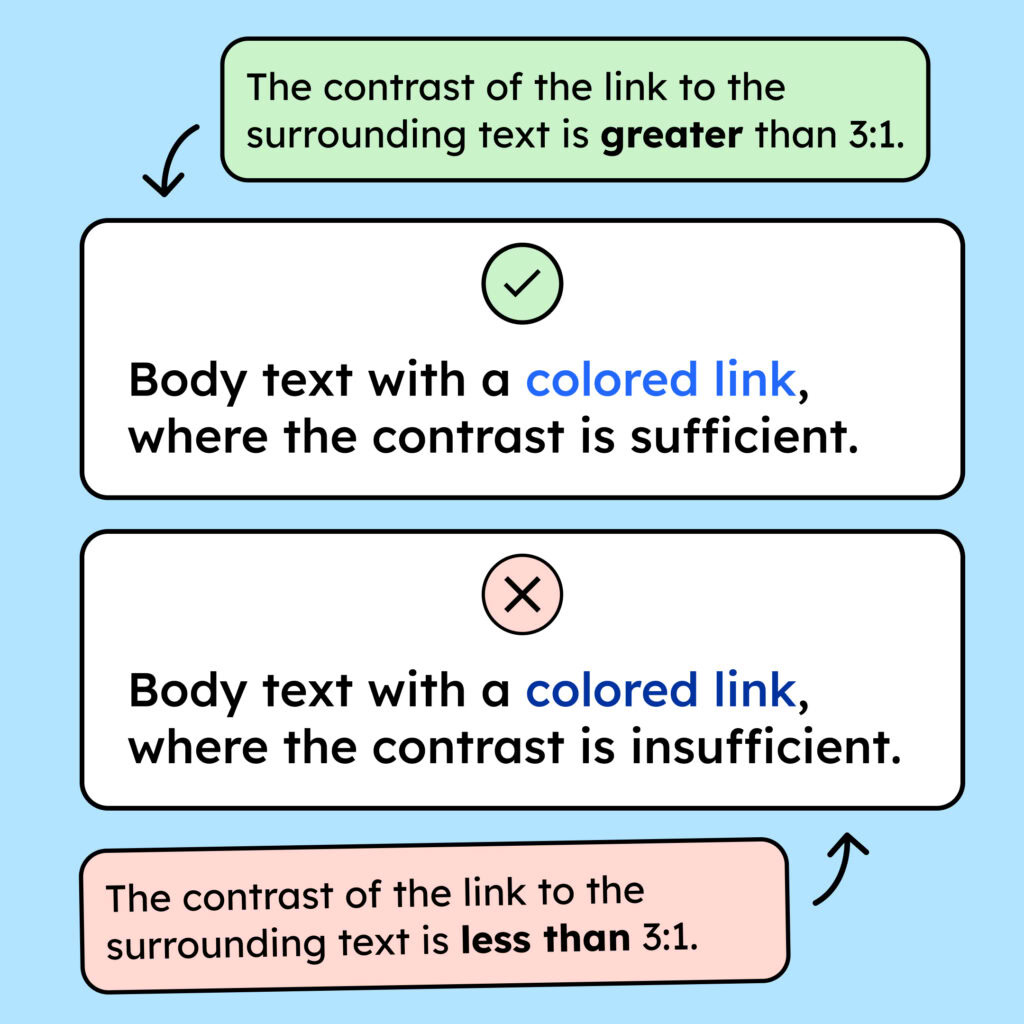
Links in body text should not only be highlighted by color but also be underlined (or otherwise distinguished).
If links in the body text are highlighted only by color, the contrast between the link color and the surrounding text must be at least 3:1. In addition, the text itself must have a contrast ratio of at least 4.5:1 against the background.
Do not convey important information in infographics through color alone
If an image distinguishes important information only through color – such as in maps or infographics – it needs to include additional patterns, symbols, or labels. This ensures that the information is still understandable without the perception of color.
The key factor is whether the color itself carries meaning. If the color green alone represents “positive,” another distinguishing feature is needed. If the colors do not have their own meaning, as in the segments of a pie chart, an adequate color contrast of at least 3:1 is sufficient

Notes
Hint: When is a contrast of over 3:1 sufficient as a difference?
When colors differ not only in hue but also significantly in brightness, this alone counts as an additional visual distinction, provided the contrast is at least 3:1 compared to the other color.
However, it’s important to note: Once exact color perception is required (e.g., green = valid, red = invalid), an additional distinguishing feature is necessary, such as symbols or text.
However, we always recommend using an additional feature. Relying solely on color contrast is not optimal for every user.

Create accessible designs?
Our workshop for designers!
Learn everything you need to know as a designer to create accessible design systems for digital products and entire brands.

Learn accessibility with us?
Looking to implement WCAG best practices in your design, development, or content workflow? Book a workshop for your team or contact us directly to learn more.