
Digital accessibility and SEO go hand in hand. An important aspect of accessibility is ensuring your website is accessible to screen readers. This means that machines must be able to read your website. A screen reader is a machine, and so are SEO bots. Both require similar structures to be properly indexed. So, if you work on one aspect, you automatically improve the other!
At the end of this article, you will find a comprehensive study by Semrush that uses figures and facts to show how helpful digital accessibility can be for your SEO.
Here are five simple steps you can take today to improve both your SEO and your accessibility.
Clean HTML structure for better accessibility and SEO
A clean HTML structure is crucial for optimal search engine optimization (SEO) and accessibility. Using semantic HTML elements clearly structures a website’s content. This allows search engines and screen readers better to understand the importance and meaning of individual sections.

A well-structured HTML interface is crucial for screen readers. By using the correct HTML elements, such as headings (h1, h2, h3, etc.) and lists, screen readers can better interpret and reproduce the content of a website. This makes it easier for people who rely on screen readers to navigate the website.
The most important requirements for your HTML structure are:
- The correct structuring of the headings (Each page has only one H1, H3s follow H2s, etc.)
- All enumerations are lists with list items
- All texts are paragraphs.
- There is a header tag, a main tag, and a footer tag.
- Non-native HTML elements have ARIA labels that describe them. Description of ARIA labels (opens in a new tab)
- Data tables are structured using proper HTML. See also: Article: Accessible Plugins for WordPress (German) (opens in a new tab)
A good structure enables all users to efficiently grasp the information on the page, regardless of their visual acuity or the assistive technologies used.
Optimize images for accessibility and SEO
To optimize images on your website for accessibility, it is important to provide meaningful alternative text (alt tags).
These alt texts help people using screen readers understand the image’s content. This not only improves accessibility but also enhances SEO, as search engines can index image descriptions.
It’s important to note, however, that you need to be clear about the role your image plays. Is it a meaningful image that provides added value? Then it needs alt text. Is it an image that’s purely decorative? Then please don’t add alt text. Descriptions of decorative images are only confusing for users.
Furthermore, you should absolutely avoid stuffing your images with SEO keywords! Here’s an interesting article on the topic: Article about SEO and accessible images (opens in a new tab).
Finally, it’s important to keep an eye on image file sizes. Compressing images improves website loading times, which benefits both users with slow internet connections and search engines. One tool for achieving excellent image compression in WordPress is Shortpixel: Shortpixel website (opens in a new tab).
Optimize videos for accessibility and SEO.
The most important measure to make videos accessible is subtitles. Subtitles enable people with hearing impairments to access the spoken content.
Additionally, transcripts should be provided to enable people who are deaf or in noisy environments to access the video content. A transcript also positively impacts SEO, as search engines can understand and index the text content.

Furthermore, you should provide clear and easily visible controls for video playback. A clearly visible playback control makes it easier for users with motor impairments to operate the videos.
The recommended video platform for embedding on your website is currently YouTube. YouTube allows you to enable subtitles. You can customize these subtitles in size, shape, and color, and the transcript is also displayed next to the text on the YouTube page itself.
For those who want to delve deeper into the topic of accessible video players, we have this link: Comparison of all web-based media players and their accessibility
Increase dwell time
Users immediately abandon inaccessible websites. This makes sense, because what’s the point of them being on a page they can’t use? This increases the bounce rate.
By making your website accessible, you enable these people to use it. This will naturally lead them to spend more time on your website and engage with its content.
Search engines view dwell time as a signal of your website’s relevance and quality. If users stay on your site longer, search engines interpret this as a positive sign, which in turn improves your ranking.
Improving your website’s accessibility can significantly reduce your bounce rate. Everyone can now navigate your site easily, which positively impacts dwell time, SEO, and your conversion rate.
Learn more about the benefits of accessibility for your business here: Article about the business case of accessibility (German)(opens in a new tab).
Expand navigation
Finally, for both accessibility and search engine optimization, it is important to provide multipleways to navigate your website.
For example, you can integrate a search function so visitors can quickly find the content they’re looking for. Or you can add a sitemap that clearly displays your website’s entire link structure and gives users a quick overview of the content.
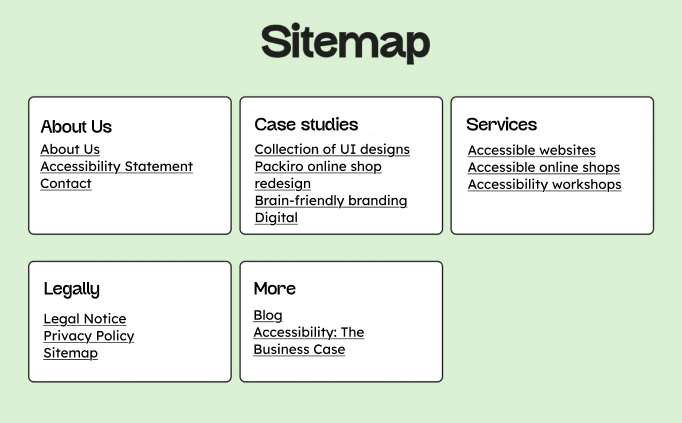
Generally speaking, if you have more than one navigation menu on your website, they should be labeled. This can be done either with hidden headings or – in our opinion, more easily – with ARIA labels that describe the navigation’s purpose. For example, a footer navigation could have the ARIA label “Legal.” This allows users of screen readers to better distinguish between the menus.

Finally, you should ensure that your menus function correctly on mobile devices and are recognized by screen readers. This means that they are completely hidden when collapsed and can no longer be accessed via the keyboard.
Accessibility and SEO: A study confirms the positive effect
Until now, there was no clear evidence that accessibility had a positive impact on search engine optimization. This changed in mid-2023 with a comprehensive study by Accessibilitychecker.org and Semrush.
This study analyzed more than 847 websites and clearly confirmed the positive effect of switching to accessibility on search engine rankings.
On average, organic traffic increased by 12%. 73.4% of participants saw an increase in their organic traffic. An impressive 66.1% of all domains even experienced an increase in their monthly organic traffic of up to 50%.
You can find the link to the detailed study with results here: Study on the influence of accessibility on SEO (opens in a new tab).

Conclusion
Digital accessibility significantly impacts a website’s SEO results. By combining accessibility and SEO, companies can increase their reach, improve user experience, and boost their visibility in search engines. This also reduces bounce rate, making the SEO effort all the more worthwhile.
By creating accessible content and applying SEO techniques, a website can be built that is accessible to all users while also achieving strong rankings in search results.